

 Posted by
 Mastering understanding icm poker requires a complete paradigm shift from standard cash game thinking, where chips directly equate to monetary value. In tournament poker, chip EV (Expected Value) and dollar EV diverge dramatically as the tournament progresses toward the money bubble and final table payouts. The Independent Chip Model (ICM) is the mathematical framework used to translate chip stacks into real-dollar equity based on the remaining payout structure and stack distributions of all players. When you fail to account for ICM pressure, you bleed money by taking high-variance spots that destroy your overall dollar expectation, regardless of what standard pot odds dictate.
The Core Mechanics of Independent Chip Model Explained
To understand the independent chip model explained, you must recognize that chips have diminishing marginal utility. The first chip you acquire in a tournament is worth significantly more than the last chip you need to win it all. In a standard cash game, doubling your stack doubles your real-world monetary value instantly. In a tournament, doubling your stack from 1,000,000 to 2,000,000 chips only increases your actual cash equity by a fraction, because payouts are top-heavy and non-linear.
Modern tournament solvers and professional players rely heavily on algorithms to calculate precise equity distributions. When calculating pot odds during a deep tournament run, raw equity calculations are completely insufficient. You must weigh your current chip equity against your potential dollar equity if you fold and let shorter stacks bust out. This fundamental reality dictates how poker player types and playing styles must adapt from loose, aggressive early-stage play to hyper-disciplined, survival-oriented strategies later on.
Chip EV vs. Dollar EV: The Core Conflict
The eternal battle in tournament strategy revolves around Chip EV (cEV) versus Dollar EV ($EV). In cEV calculations, you make decisions purely to maximize your chip accumulation, treating chips as infinite and infinitely valuable. However, because tournaments end when all chips are consolidated and payouts are fixed, dollar EV rules supreme.
Consider a classic bubble scenario where you hold a medium stack. The chip leader goes all-in from late position, covering everyone behind. Standard pot odds might dictate a profitable call using basic texas hold ’em starting hands like . However, if your elimination means multiple smaller stacks make the money, calling and losing destroys your $EV. You are risking your entire tournament life while other players ladder up risk-free.
Navigating the ICM Pressure Bubble
The bubble is where ICM exerts maximum force on the tournament ecosystem. The icm pressure bubble creates structural asymmetries in how ranges interact. Short stacks are forced to play an extremely polarized shove-or-fold strategy, while medium stacks must dramatically tighten their opening and calling ranges to avoid elimination.
Conversely, big stacks possess absolute fold equity over medium and short stacks. A chip leader can open a wide linear range from late position, applying maximum pressure because they can comfortably absorb losses while opponents face tournament-ending elimination decisions. When playing against these dynamics, understanding drawing hands and semi-bluffs requires calculating whether your implied odds compensate for the catastrophic loss of dollar equity if your draw bricks out.
Final Table ICM Strategy and Payout Ladders
As the field dwindles to a final table, steep payout jumps introduce severe ICM pressure. The difference between finishing 9th and 8th might be a few thousand dollars, but the gap between 2nd and 1st is often life-changing. Elite tournament grinders exploit these massive pay jumps by targeting medium stacks who are terrified of laddering down. If you want to expand your arsenal, studying suited connectors poker dynamics helps you realize equity post-flop against capped ranges without committing your entire stack unnecessarily.
When executing a poker semi-bluff at a final table, your Minimum Defense Frequency (MDF) must account for opponents’ reluctance to call off light. Because opponents fold far more often than GTO cash game models suggest, your bluffs print instant profit regardless of river card runouts.
Advanced Real Hand Breakdown: Bubble Dynamics
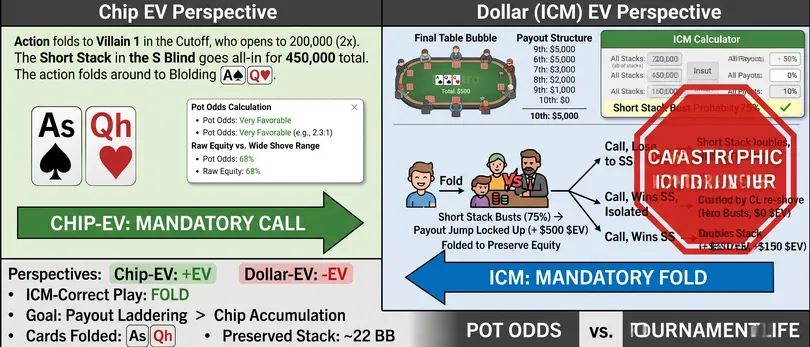
To ground these mathematical concepts in reality, let us analyze a concrete hand played on the final table bubble of a major online tournament. Blinds are 50,000 / 100,000 with a 100,000 big blind ante. There are 10 players remaining, and the next elimination is the direct bubble before the final table.
Stack Sizes:
– Villain 1 (Chip Leader in the Cutoff): 4,500,000 chips (45 BB)
– Hero (Medium Stack in the Big Blind): 2,200,000 chips (22 BB)
– Short Stack (In the Small Blind): 450,000 chips (4.5 BB)
Action folds to Villain 1 in the Cutoff, who opens to 200,000 (2x). The Button folds, and the Short Stack in the Small Blind goes all-in for 450,000 total. The action is now on Hero in the Big Blind holding .
From a purely chip-EV perspective, continuing with this premium hand might seem mandatory. Your crushes the short stack’s wide shoving range. However, when we run this spot through an ICM calculator, the picture changes entirely. If Hero folds, the short stack is all-in and at extreme risk against the original raiser. The probability that the short stack busts is roughly 75%. If the short stack busts, Hero locks up a massive payout ladder jump.
By getting involved (either by flat calling and inviting a reshove from Villain 1, or by reshoving themselves), Hero puts their entire tournament life at risk against the chip leader. Solvers indicate that entering this pot is a catastrophic ICM blunder; Hero must fold and preserve their medium stack equity.
Strategic Matrix: Stack Dynamics & ICM Pressures
The following matrix outlines how different stack sizes must adjust their strategy based on ICM pressure during bubble phases and final tables:
| Stack Category | Bubble Phase Strategy | Final Table Adjustment | Key Mathematical Driver |
|---|---|---|---|
| Short Stack (< 12 BB) | Hyper-polarized shove/fold; ignore standard ranges. | Must jam wider over medium stack opens to ladder. | Maximal fold equity exploitation & survival. |
| Medium Stack (15-30 BB) | Extremely tight folding range; avoid confrontations. | Isolate short stacks; avoid clashing with chip leaders. | Diminishing marginal chip utility. |
| Chip Leader (> 50 BB) | Aggressive bullying; exploit medium stack fear. | Wide linear opens; apply maximum pressure on jumps. | Leveraging absolute stack supremacy. |
Conclusion: Mastering ICM for Tournament Supremacy
Integrating ICM principles into your tournament strategy separates professional winners from break-even recreational players. By acknowledging that chips lose marginal value as stacks grow, you eliminate costly chip-EV mistakes that bleed your bankroll during high-stakes bubble phases and final tables. Always evaluate your decisions through the lens of dollar equity rather than raw pot odds, ensuring every calculated risk directly maximizes your long-term return on investment.
To exploit your opponents effectively, target medium stacks who exhibit irrational fear of payout jumps. Utilize software tools and ICM calculators away from the felt to study diverse stack configurations, range interactions, and shove-or-fold thresholds. When you master these mathematical dynamics, you command the table with cold, unyielding precision.
FAQ: Understanding ICM (Independent Chip Model) in Tournaments
ICM stands for Independent Chip Model. It is a mathematical formula used to calculate the real-dollar monetary equity of a player’s chip stack in a tournament based on the remaining prize pool distribution.
On the tournament bubble, ICM pressure dictates that the risk of elimination outweighs the reward of accumulating more chips. Medium stacks lose more dollar EV by busting than they gain by doubling up, making disciplined folds mathematically correct.
Input the exact payout structure, remaining player count, and all active chip stacks into an ICM software tool. This reveals your exact dollar equity and helps determine optimal push/fold ranges.
🎯 Ready to test your poker skills? Put your strategy into practice and claim premium rewards on our top-rated poker platforms:

➡️ Play on CoinPoker — Enjoy anonymous blockchain-based tables, 15% Daily Guaranteed Rewards, and instant, low-fee USDT cashouts.

➡️ Play on TigerGaming Poker — Experience ultra-soft cash games filled with recreational sports bettors, plus a 100% deposit bonus up to $1,000.


Facebook Comments