

 Posted by
 Effective poker tilt control requires a rigorous mathematical understanding of variance, Expected Value (EV), and emotional discipline. When a bad beat disrupts your session, your brain’s amygdala triggers a fight-or-flight response, instantly degrading your decision-making quality. Elite regulars treat tilt not as a moral failure, but as a leak in their win-rate that requires immediate containment through structured bankroll tilt prevention, strict Minimum Defense Frequency (MDF) adherence, and objective hand reviews. Understanding the exact mechanics of variance allows you to separate short-term outcomes from long-term profitability, keeping your cognitive capital intact.
The Anatomy of Tilt: Neuroscience Meets GTO Poker
When studying the mental game of poker, players must recognize that tilt manifests in multiple ways, ranging from explosive rage to subtle apathy, often referred to as “dead card tilt” or “card-dead depression.” Game Theory Optimal (GTO) solvers operate without emotion, calculating frequencies based strictly on range advantage, nut advantage, and equity realization. Humans, however, suffer from cognitive biases such as recency bias and loss aversion. When you experience a brutal river card against a fish who called off with suboptimal pot odds, your physiological state shifts. Heart rate elevates, cortisol spikes, and your ability to calculate pot odds accurately plummets.
To combat this, you must treat your emotional bankroll with the same rigor you apply to your financial bankroll. If your Stack-to-Pot Ratio (SPR) calculations become sloppy after losing three buy-ins in a row, your poker mental toughness has been compromised. The most profitable regs do not claim they never feel frustrated; instead, they possess automated circuit breakers that halt play the moment their strategy deviates from standard equilibrium play into polarized or linear spewing.
How to Avoid Tilt in Poker Using Range Analysis
One of the primary catalysts for mental breakdown is misunderstanding variance. Many players struggle with how to avoid tilt in poker because they evaluate their sessions based on results rather than decision quality. If you get all-in preflop with against , you hold roughly 82% equity. When a king spikes on the river, your brain screams that the poker gods are punishing you. In reality, you executed a mathematically flawless preflop shove.
To master poker tilt management, you must anchor your confidence in your preflop charts and post-flop execution. Reviewing your session through a solver lens reveals whether your starting hands selection matched optimal thresholds, or if tilt crept in quietly by causing you to widen your ranges with marginal suited connectors out of position. If you want to refine how you approach different playing styles without losing your cool, maintaining a strict adherence to board-texture blockers and MDF is mandatory.
Real Hand Breakdown: Emotional Discipline Under Pressure
Let us analyze a high-stakes 6-max cash game hand where poker tilt control is tested to its absolute limit. Effective stacks are 100 big blinds ($1,000).
Preflop: Hero is in the Cutoff with . Villain opens from UTG to $2.50. Hero 3-bets to $8. Villain calls. Pot size: $17.50.
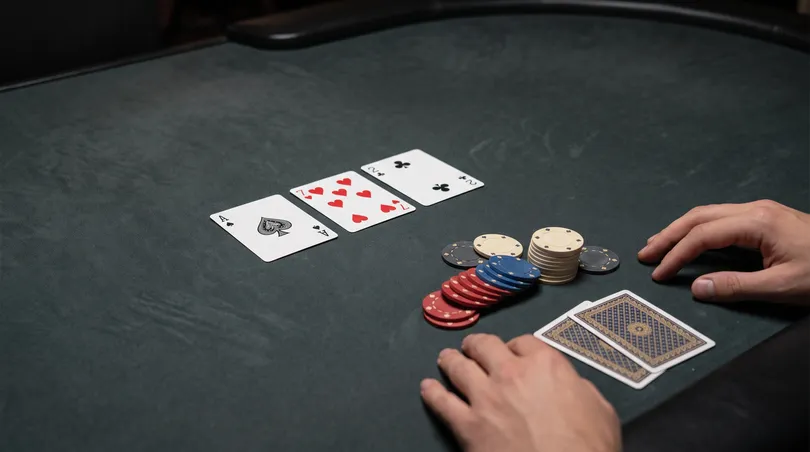
Flop: . Villain checks. Hero bets $6 (35% pot). Villain check-raises to $22. Pot size: $61.50.
The Dilemma & Tilt Trigger: This board texture heavily favors the UTG opener’s continuing range, which is densely packed with sets of aces and two pair combinations. A tilting player will often let anger dictate their action here, either rage-folding out of disgust or stubbornly flat-calling or shoving out of spite (“I’m not letting him push me around!”). A disciplined regular uses solid semi-bluff defense frequencies and evaluates blocker effects. Because Hero holds a queen of spades, blocking nut flush draw combos, and neither player has an obvious drawing hands advantage without spades, calculating exact fold equity and pot odds dictates whether a disciplined fold or continuation is correct.
Actionable Poker Psychology Tips for Long-Term Grinders
Implementing concrete poker psychology tips into your daily routine transforms your win-rate far more than running additional solver simulations. When playing online, enable strict session-stop loss limits in your poker software. If you drop three buy-ins within a 90-minute window, lock the client. Do not trust your emotional state to keep you honest; build structural boundaries that protect you from yourself.
Furthermore, integrate mindfulness techniques during table breaks. Step away from the screen, hydrate, and detach your self-worth from your session graph. Recognizing that even the best players in the world experience downswings lasting tens of thousands of hands provides the necessary psychological insulation against destructive tilt.
Comparative Strategy Matrix: Emotional vs. Analytical Play
| Situation / Trigger | Emotional Response (Tilt Active) | Analytical Response (GTO & Discipline) |
|---|---|---|
| Bad Beat on the River | Rage-shove wider ranges; seek immediate revenge. | Log hand history; verify equity preflop; accept variance. |
| Card-Dead Streak for 2 Hours | Spew chips with marginal suited connectors out of boredom. | Maintain tight starting-hand charts; preserve mental energy. |
| Aggressive Fish 3-Bets Light | Call out of spite; abandon position and board texture. | Exploit opponent tendencies; execute balanced 4-bet or fold lines. |
| Downswing Across 5 Sessions | Move up in stakes to “win it back” quickly. | Review bankroll management rules; drop down a stake if necessary. |
Conclusion: Master Your Mindset to Dominate the Felt
Achieving mastery over your emotions is the ultimate competitive edge in modern poker, where technical skill gaps between regulars continue to shrink. By treating your mental game with the same analytical precision you apply to hand histories, pot odds, and range construction, you insulate your hard-earned bankroll from catastrophic emotional downswings. Implementing automated stop-losses, recognizing the physiological warning signs of tilt, and anchoring your confidence in long-term EV will permanently elevate your performance.
Opponents who fail to control their mental state provide the easiest profit targets in the game. When you remain a pillar of analytical stability while the rest of the table unravels after a bad beat, you capture maximum value from their compounding mistakes. Protect your mindset, stick to your ranges, and let mathematics guide every decision you make at the table.
Conclusion: Building Long-Term Poker Mental Toughness
Mastering poker tilt control is just as critical to your winrate as learning proper preflop ranges or pot odds. By identifying your tilt triggers, implementing strict stop-loss rules, and understanding how to avoid tilt in poker during bad runs, you transform your mindset into a major competitive advantage.
Remember that protecting your mindset goes hand in hand with protecting your funds. To strengthen your overall poker foundation, combine these mental game strategies with our complete guides on Bankroll Management for Beginners, Poker Player Types and Styles, and GTO Poker Strategy.
FAQ: Poker Tilt Control Strategies: Mastering Your Mental Game
Poker tilt control refers to the psychological and structural techniques used to prevent emotional frustration from ruining your decision-making. It is vital because emotional play destroys your win-rate, turning profitable sessions into massive losses.
To avoid tilt during a downswing, set strict stop-loss limits per session, step away from the tables to reset your cognitive state, and focus strictly on decision quality rather than short-term financial results.
Key poker psychology tips include accepting variance as a normal part of the game, maintaining a properly sized bankroll to absorb downswings, and never playing poker when fatigued, stressed, or angry.
🎯 Ready to test your poker skills? Put your strategy into practice and claim premium rewards on our top-rated poker platforms:

➡️ Play on CoinPoker — Enjoy anonymous blockchain-based tables, 15% Daily Guaranteed Rewards, and instant, low-fee USDT cashouts.

➡️ Play on TigerGaming Poker — Experience ultra-soft cash games filled with recreational sports bettors, plus a 100% deposit bonus up to $1,000.


Facebook Comments