
 Posted by
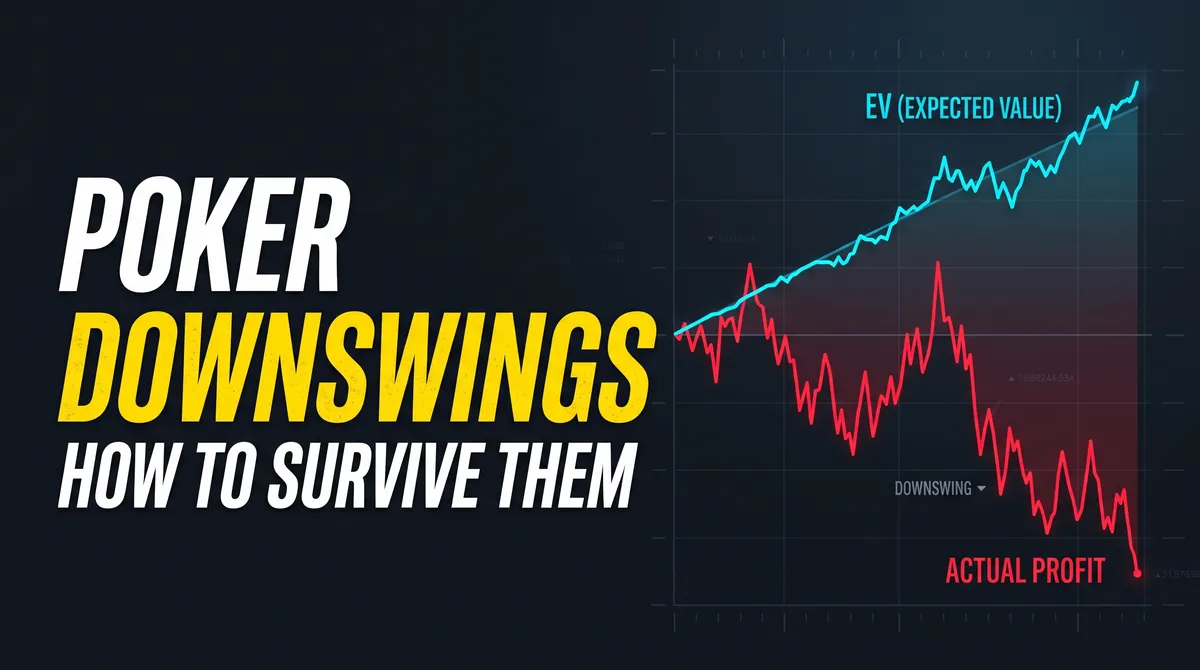
A poker downswing is an extended losing streak driven primarily by negative statistical variance rather than bad play. During a downswing, a winning player loses buy-ins over thousands of hands due to coolers and bad beats. While unavoidable mathematically, disciplined bankroll management and emotional control mitigate their severe financial impact.


Understanding Poker Downswings: The Reality of Variance
Every player who grinds with any regularity knows that booking a profit in every single session is impossible. You will inevitably experience sessions where you lose far more than you win, and in many instances, you are entirely powerless to prevent it.
While profitable poker fundamentally demands technical skill, mathematics, and tactical discipline, luck exerts a massive short-term influence on the outcome of any individual session. That dynamic will never change. Anyone putting in consistent volume across major online poker rooms or live venues recognizes that negative variance can run against you far longer than anticipated, frequently making it feel as though the cold streak will never end.
Encountering a Major Downswing at the Tables
As regular cash-game or tournament competitors, losing two to three buy-ins during a session is standard territory. Experienced players factor these swings into everyday expectation. However, every so often, dropping a couple of buy-ins proves to be merely the tip of the iceberg, ushering in an agonizing, seemingly endless stretch of brutal runouts and missed draws.
During these harsh stretches, everything appears to go wrong simultaneously:
- You lose virtually every preflop and postflop coin flip.
- None of your flush draws or open-ended straight draws complete.
- Your starting hands completely miss favorable flop textures.
- Premium holdings like repeatedly get outdrawn by weaker holdings such as or .
You might reassure yourself: “This is just normal variance; it cannot last forever, and things will balance out soon.” Yet just as you muster some optimism, you pick up , commit your chips, and watch an inevitable spike right across the flop.
The Psychological Toll of Prolonged Downswings
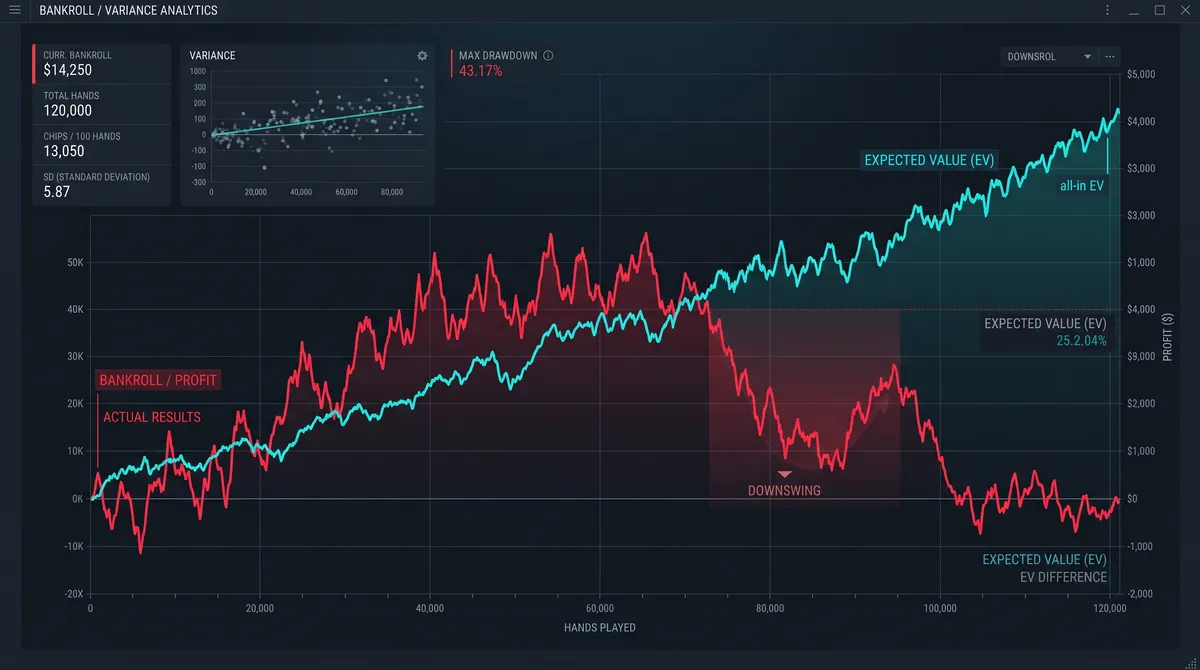
The primary hazard of extended poker downswings is that they lie completely outside your direct control. No tactical adjustment, flawless line, or subtle read can prevent standard statistical distribution from taking its course. As the losing streak drags on, players inevitably begin second-guessing their fundamental abilities, wondering if they have permanently lost the skill to win money.
This self-doubt frequently triggers destructive strategic compensations. Players alter solid strategies to force action, chase losses, or make overly cautious folds. Paradoxically, this altered approach proves far inferior to their baseline strategy, bleeding off significantly more capital than if they had simply maintained their original game plan.
When enduring a severe downswing, players almost universally ask two frantic questions:
- What am I doing wrong?
- What can I do to stop this downswing right now?
The candid answers are: nothing, and nothing. While blunt, this is the mathematical truth. If you are a fundamentally disciplined player executing solid A-game decisions, your technical process remains sound.
Every serious poker player will eventually confront deep downswings that span multiple sessions, weeks, or even tens of thousands of hands. Your only fault is running on the wrong side of statistical probability over an isolated sample size. Because you cannot dictate which cards hit the board, you cannot artificially halt a downswing on demand.
How to Navigate and Recover From a Downstreak
The most reliable advice during an agonizing run of negative sessions is to recognize that variance is temporary. Regardless of how long the tunnel feels, mathematical distribution eventually stabilizes. Your premium holdings will hold, your draws will get there, and your bankroll trajectory will turn around.
Maintain an objective mindset and refuse to abandon your proven edge. If a disciplined strategy yielded steady profits over months of sample volume, a few consecutive weeks of poor runouts do not transform you into a losing player overnight.
However, if relentless coolers begin eroding your emotional composure or degrading your decision-making into passive play or reckless tilt, step away from the tables immediately. Taking a break for roughly a full week is usually sufficient to clear out mental toxicity, reset your nervous system, and restore clarity. Returning with a refreshed perspective allows you to play clean poker completely untethered from recent bad beats.
| Downswing Stage | Common Symptoms | Recommended Action |
|---|---|---|
| Early (2–5 Buy-ins) | Standard coolers, missed coin flips, minor annoyance | Maintain normal volume; verify your technical fundamentals in solver/tracker. |
| Intermediate (6–15 Buy-ins) | Second-guessing lines, altering preflop ranges, frustration | Drop down in stakes temporarily; review hands away from tables to verify play. |
| Severe (15+ Buy-ins) | Entrenched tilt, chasing losses, feeling helpless | Enforce a strict 5–7 day complete poker hiatus; reset mental equilibrium. |
Conclusion: Surviving Poker Downswings with Discipline
Navigating poker downswings requires accepting that short-term results never reflect long-term technical quality. The two vital takeaways from this reality are maintaining strict bankroll depth to absorb inevitable downswings and refusing to adjust winning strategic baselines out of desperation. By protecting your emotional state and letting the mathematics resolve themselves, you shield your overall winrate and preserve critical operating capital.
When the deck runs cold, your sole objective is minimizing unnecessary loss by playing disciplined poker on every street. To bulletproof your mindset against emotional erosion during brutal coolers, master practical poker tilt control strategies to protect your bankroll, and build a rock-solid structural foundation with our detailed primer on how to play poker for beginners.
FAQ: Poker Downswings
No. Downswings are an inherent mathematical reality of poker variance. Even top-tier professional players with exceptional winrates endure extended breakeven or losing stretches due to natural card distribution.
Changing your strategy to chase losses or avoid coolers usually introduces passive errors or hyper-aggressive bluffs. Deviating from your proven baseline degrades your edge and inflates financial losses further.
A complete break lasting five to seven days is typically optimal. This timeframe clears psychological frustration, eliminates subconscious tilt, and allows you to return to the tables with total analytical clarity.
🎯 Inspired by the News? Ready to Play?
Test your poker strategy and claim premium bonuses at our top-rated US-friendly poker platforms:

CoinPoker — #1 Crypto Poker Room
Enjoy anonymous blockchain tables, 33% rakeback, and instant USDT cashouts.

BetOnline — Best Soft Cash Games
Experience ultra-soft cash games filled with recreational players, plus a 100% deposit bonus up to $1,000.
Facebook Comments