

 Posted by
Playing at loose poker tables can be highly profitable, but it requires specific strategic adjustments to manage increased variance. By distinguishing between loose-passive and loose-aggressive environments, you can adapt your starting hand ranges and post-flop play to exploit opponent tendencies, ultimately protecting your bankroll and increasing your long-term winrate.


What is a Loose Table?
In poker, “loose” refers to players who play a wide range of hands pre-flop. When several such players gather at one table, many pots become multi-way. To succeed, you must distinguish between two types: loose-passive and loose-aggressive.
At loose-passive tables, players frequently limp and call, creating small, multi-way pots. At loose-aggressive tables, players frequently raise and re-raise, creating large pots with fewer players involved. Identifying these types via lobby statistics—such as the average number of players to the flop and the average pot size—is the first step to adjusting your strategy.
Strategy for Loose-Passive Tables
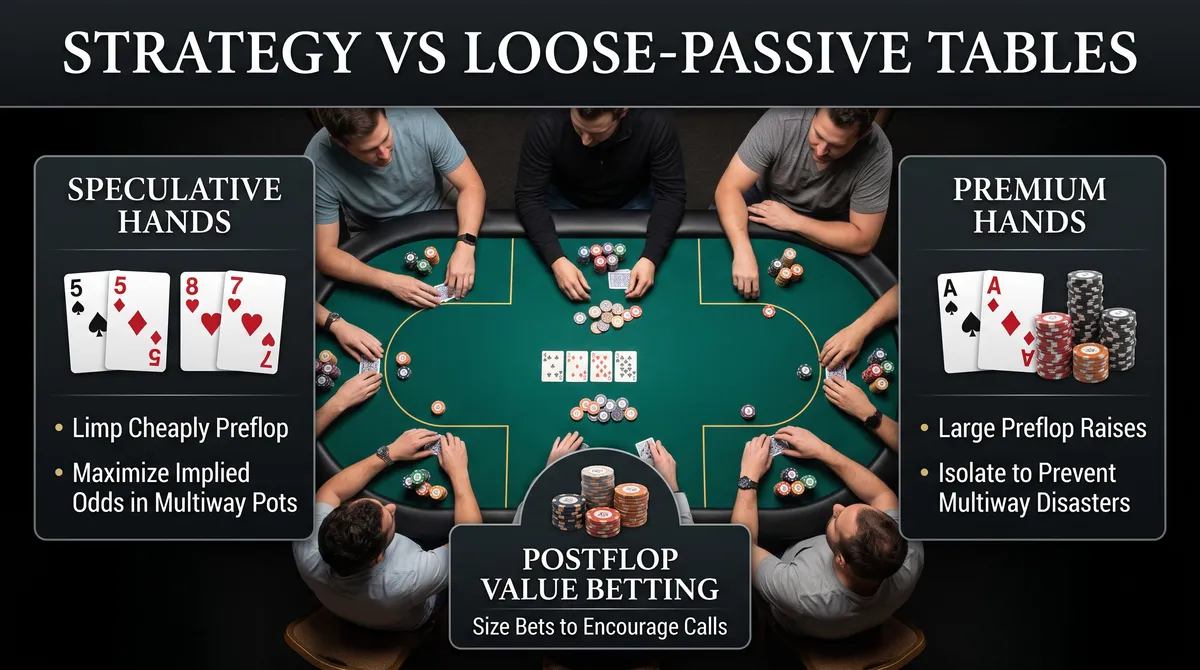
Adjusting to loose-passive tables depends on your opponents’ tendency to call raises. These players often have a wide gap between their limping/calling range and their raising range. Because they rarely re-raise, you can profitably limp with high-implied-odds hands like small pairs and suited connectors to see cheap flops in multi-way pots.
- Value Betting: If you hit a monster, avoid betting too large, as you may force out passive opponents. Size your bets to encourage calls and build the pot gradually.
- Premium Hands: Play premium pairs with strong, tight raises. Small raises often invite multiple players to see a flop, which can be disastrous for hands like pocket Aces on dangerous boards.
Strategy for Loose-Aggressive Tables
Loose-aggressive tables require a different approach. You should only play speculative hands like small pairs or suited connectors when you are closing the action pre-flop. From early positions, these hands should be folded due to the high frequency of raises and re-raises.
Premium pairs should be played aggressively to build large pots, ideally against a single opponent. On the post-flop, you will rarely get a “free card.” Against aggressive players, playing in position is vital. If you call a flop bet, they may check the turn, allowing you to take a free card to hit your draw.
Table Image
Your table image influences your strategy. If you have been playing a loose-aggressive style, do not fall into the trap of checking with a monster hand. Observant players will notice the deviation from your usual betting pattern, and you will miss out on extracting value on later streets.
| Table Type | Pre-flop Strategy | Post-flop Strategy |
|---|---|---|
| Loose-Passive | Limp with implied odds hands; raise premiums | Value bet small; avoid semi-bluffs |
| Loose-Aggressive | Fold speculative hands early; 3-bet premiums | Play in position; call to induce checks |
Conclusion: Mastering Loose Table Adjustments
To succeed at loose poker tables, you must master the art of adaptation. The two core takeaways are: first, adjust your pre-flop range based on the table’s aggression level to avoid being trapped in bloated pots with weak hands; second, tailor your post-flop sizing to either extract maximum value from passive callers or neutralize the pressure from aggressive opponents. These adjustments are essential for maintaining a positive ROI in high-variance games.
Always observe the table dynamics before committing your stack. For a deeper understanding of how to leverage your position and betting, review our guides on fold equity and how to calculate pot odds to ensure your decisions remain mathematically sound.
FAQ: Loose Poker Tables
Look for high percentages of players seeing the flop (40-60%) combined with small average pot sizes in the lobby statistics.
Generally, no. Passive players are prone to calling, making pure bluffs or semi-bluffs unprofitable. It is better to check behind and realize your equity.
Play them aggressively pre-flop to build a large pot, ideally narrowing the field to one opponent to maximize your equity and potential for a 4-bet.
🎯 Inspired by the News? Ready to Play?
Test your poker strategy and claim premium bonuses at our top-rated US-friendly poker platforms:

CoinPoker — #1 Crypto Poker Room
Enjoy anonymous blockchain tables, 33% rakeback, and instant USDT cashouts.

BetOnline — Best Soft Cash Games
Experience ultra-soft cash games filled with recreational players, plus a 100% deposit bonus up to $1,000.
Facebook Comments