
 Posted by
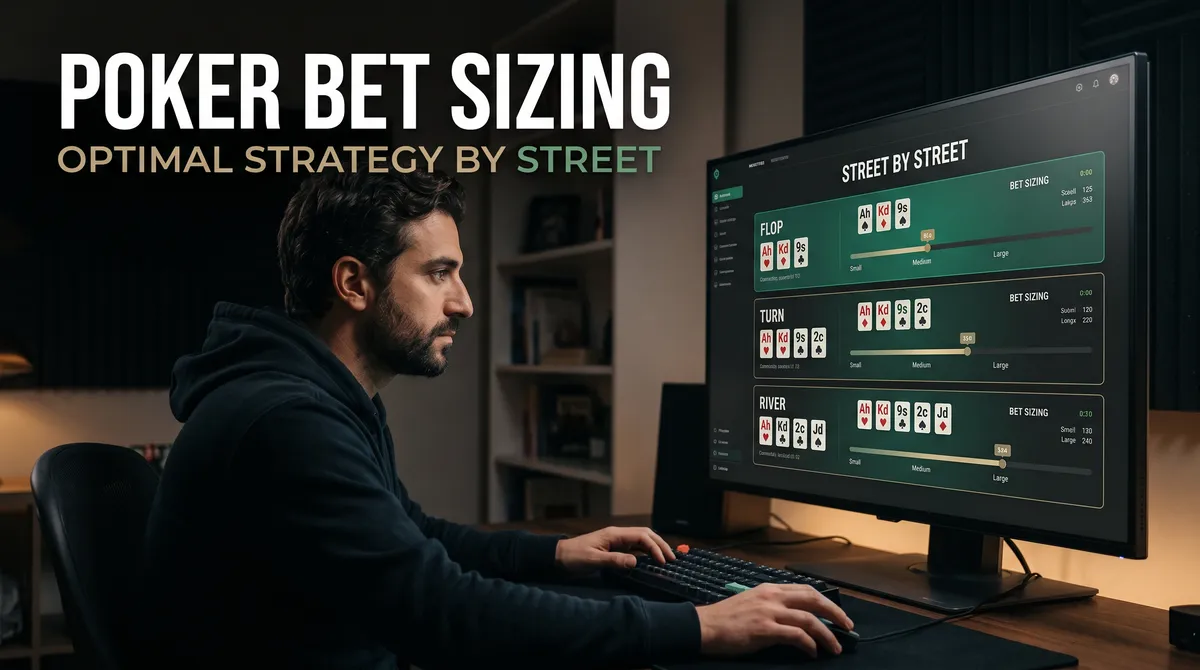
Poker bet sizing dictates the exact number of chips you wager or raise across every street. Optimal bet sizing extracts maximum value from weaker holdings, generates fold equity on bluffs, and denies drawing hands favorable pot odds. Sizing scales relative to the total pot, board texture, effective stacks, and player ranges.


There is no one-size-fits-all bet size for every hand in No-Limit Hold’em. Sizing decisions must reflect current pot size, table position, effective stack depths, board texture, range advantages, and opponent tendencies. Mastering these variables allows you to execute purposeful bets that maximize expected value (+EV).
What Bet Sizing Is and Why It Matters
Always evaluate your wager relative to the size of the pot. A $5 bet can be an aggressive, pot-sized bomb into a $6 pot, yet an insignificant tick into a $40 pot. For this reason, postflop bets are measured as percentages or fractions of the pot, whereas preflop raises are measured in big blinds (BB).
Every bet must accomplish a distinct tactical goal. When holding a strong value hand, your objective is to receive calls from worse holdings. When bluffing, your objective is to fold out hands with superior showdown value. Betting purely “for information” is a losing play that leaks chips, because an opponent’s response is governed by position and range dynamics, not simply their exact hand strength.
Key Factors Determining Your Bet Size
Before selecting your bet size, analyze the following strategic parameters:
- Purpose of the Bet: Whether you are value betting, bluffing, or denying equity, your chosen sizing must encompass both value hands and bluffs to remain balanced and unpredictable.
- Board Texture: Dry, uncoordinated boards require smaller bets to accomplish their goals. In contrast, wet, dynamic boards rich in straight and flush draws require larger sizing to charge drawing ranges.
- Range Advantages: Possessing a nut advantage enables you to apply immense pressure. Narrow, polarized ranges typically demand larger sizing, whereas wide, merged ranges favor smaller bets.
- Position and Stack Depths: Playing out of position is inherently disadvantaged and often warrants larger sizing. Furthermore, lower stack-to-pot ratios (SPR) accelerate pot commitment and stack-off thresholds.
- Opponent Tendencies: Against recreational players who call excessively (“calling stations”), scale up your value bet sizing. Against timid opponents who over-fold, leverage cheap, small-sized bluffs.
Never telegraph your exact hand strength by altering your bet sizing based solely on absolute hand value. If you bet large with nut hands and small with air or marginal holdings, observant adversaries will exploit you effortlessly.
Preflop Bet Sizing Guidelines
In modern online poker games, standard open-raises typically range from 2 to 2.5 BB. In low-stakes live games or soft online pools where players call too frequently, sizing up to 2.5 to 3 BB is standard to punish loose continuing ranges. From the small blind, open-raising to a larger size (3 to 3.5 BB) is standard because the big blind retains position throughout the entire postflop tree.
When facing limpers, add approximately 1 BB for each limper already in the pot. For example, if your baseline open is 2.5 BB and two players limp ahead of you, your standard isolating raise should be 4.5 BB. If you are out of position, adding an extra big blind is recommended.
For standard 3-bets, aim for roughly 3x the original open-raise when you have position, and increase to roughly 4x the open-raise when out of position. Never increase your 3-bet size solely with premium pocket pairs; consistent sizing protects the weaker thresholds of your 3-betting range.
Standard Preflop Sizing Benchmarks
| Scenario | Standard Benchmark | Strategic Consideration |
|---|---|---|
| Open-Raise | 2.0 – 3.0 BB | Game format, table position, and general calling tendencies. |
| Isolating Limpers | Base open + 1 BB per limper | Add an extra 1 BB when isolating from out of position. |
| 3-Bet In Position | ~3x the original raise | Account for effective stack depths and opener’s range. |
| 3-Bet Out of Position | ~4x the original raise | Compensates for the positional disadvantage postflop. |
How to Choose Postflop Sizing
The outdated advice of “always bet 3/4 of the pot” is far too crude for competitive poker. While 75% pot has its place, firing that size on an ultra-dry board often folds out the exact marginal hands you want calls from. Match your sizing to the board texture and range composition.
Small Bets (25% to 33% Pot): Ideal for dry, disconnected flops where the defender holds a wide distribution of weak hands. Small bets generate cost-effective bluffs and allow you to bet at high frequencies across a broad range while extracting calls from underpairs and backdoor floats.
Medium Bets (50% to 75% Pot): Most effective on semi-coordinated boards where opponents have many pairs and draws. This sizing balances value extraction with charge pricing, forcing opponents to pay meaningful amounts to continue.
Large Bets and Overbets (75% to 100%+ Pot): Typically reserved for polarized ranges containing monster value hands and high-equity bluffs, omitting medium-strength showdown value. Overbets maximize value against capped ranges and exert maximum leverage on river runouts.

Always plan future streets ahead of time. If your plan is to fire three streets of value across the flop, turn, and river, calculate the geometric sizing needed to get stacks in by the river. A flop bet that is too small might leave you with an awkward, non-committing SPR on the river, while a flop bet that is too large collapses your opponent’s range exclusively to monster hands.
How Bet Sizing Dictates Pot Odds
The size of your bet directly dictates the pot odds offered to your opponent, determining the minimum equity they require to continue profitably. Without factoring in implied odds or future playability, direct pot odds scale systematically with your bet size:
| Wager Size (% Pot) | Pot Odds Offered to Opponent | Minimum Direct Equity to Call |
|---|---|---|
| 1/3 Pot (33%) | 4 to 1 | 20.0% |
| 1/2 Pot (50%) | 3 to 1 | 25.0% |
| 2/3 Pot (66%) | 2.5 to 1 | 28.6% |
| 3/4 Pot (75%) | 2.33 to 1 | 30.0% |
| Full Pot (100%) | 2 to 1 | 33.3% |
Understanding these thresholds does not imply you should blindly bet full pot whenever an opponent might hold a draw. The goal is always to maximize overall expected value across your entire range, rather than simply attempting to force a single specific drawing hand into folding.
Common Bet Sizing Mistakes to Avoid
Most postflop bankroll leaks stem from repetitive bet sizing errors:
- Using a Single Static Sizing on Every Board: Ignoring flop connectivity and range advantages results in betting too large on dry textures and undercharging on wet textures.
- Sizing Tells: Betting tiny with strong holdings to “trap” while bombing big when bluffing. Experienced players will rapidly exploit this transparent pattern.
- The “Protect at All Costs” Mentality: Over-betting vulnerable value hands purely to avoid being sucked out on often leaves you called only by hands that beat you.
- Ignoring Effective Stack Depths: Failing to map out the pot-to-stack ratio across future streets can ruin river commitments and prevent full stack extraction.
- Cross-Contaminating Tournament and Cash Sizing: Deeper cash game structures require different sizing thresholds than shallow tournament play with active antes.
Hand Example: Adjusting Sizing by Board Texture
Suppose you open-raise preflop and receive a call from the big blind. On a dry, disconnected rainbow flop, a small continuation bet of roughly 25% to 33% of the pot keeps weak pairs, underpairs, and backdoor floats in your opponent’s continuing range. Firing 75% pot on this board narrows their range exclusively to top-tier hands, sacrificing value against the wide swath of hands they would gladly defend against a smaller wager.
Conversely, on a dynamic, highly connected board featuring flush and straight possibilities, your opponent’s range retains substantial equity through combo draws, pair-plus-draws, and second pairs. Here, a medium-to-large bet of 66% to 80% pot extracts value from worse made hands while pricing out draws by offering unfavorable pot odds.
| Board Texture | Recommended Sizing | Strategic Objective | Range Profile |
|---|---|---|---|
| Dry / Disconnected | 25% – 33% Pot | High c-bet frequency, cheap bluffs, keeping weak hands in | Wide, range-driven advantage |
| Dynamic / Coordinated | 66% – 80% Pot | Value extraction, denying equity to draws, charging pairs | Linear to polarized strength |
| Paired / Monotone | 33% – half pot | Controlled pot growth, pot control with marginal hands | Cautious, equity-preserving |
| Blank River (Nut Advantage) | 75% – 125%+ Pot | Maximizing value with monsters, maximum bluff fold equity | Strictly polarized range |
Conclusion: Developing Intentional Sizing at the Tables
Executing accurate poker bet sizing starts with defining the strategic objective of your wager before reaching for your chips. By structuring your preflop open sizes around table position and limpers, and adapting postflop bets to board textures, range distributions, and effective stack depths, you eliminate critical sizing tells while extracting maximum value from your entire range. Over thousands of hands, replacing careless slider dragging with intentional sizing directly drives a sustainable increase in winrate and ROI.
To implement these concepts during live and online play, review key hands after every session where you hesitated between two sizing options. Deepen your understanding of these dynamics by learning how to calculate pot odds in poker and discover how to leverage fold equity in poker to maximize the profitability of your bluffs.
FAQ: Poker Bet Sizing
There is no single universal standard. Sizing ranges from small (25% to 33% of the pot) on dry boards to medium or large (66% to 75%+ of the pot) on dynamic, coordinated textures based on your range advantage and strategic purpose.
Often yes, provided the opponent’s range is saturated with draws. Sizing up charges them an unfavorable price to see future cards, but your large bet must still be capable of getting calls from weaker made hands or balanced with appropriate bluffs.
Yes. Exploitative adjustments are highly profitable against recreational players. If a calling station routinely calls regardless of size, increase your value bet sizing to extract maximum profit; conversely, use smaller sizes when bluffing against chronic over-folders.
🎯 Inspired by the News? Ready to Play?
Test your poker strategy and claim premium bonuses at our top-rated US-friendly poker platforms:

CoinPoker — #1 Crypto Poker Room
Enjoy anonymous blockchain tables, 33% rakeback, and instant USDT cashouts.

BetOnline — Best Soft Cash Games
Experience ultra-soft cash games filled with recreational players, plus a 100% deposit bonus up to $1,000.
Facebook Comments