

 Posted by
 Learning to play poker in 2026? You are in the right place. Knowing how to play poker for beginners starts with mastering the basic rules, poker hand rankings, and the four betting rounds: pre-flop, flop, turn, and river. In Texas Hold’em, your objective is to form the best five-card combination using two private hole cards and five shared community cards. By adopting a solid beginners poker strategy—such as folding weak hands, using your table position, and managing your bankroll—you can safely transition from a complete novice to a confident, winning player.
1. How to Play Poker for Beginners: Understanding the Table
Before you sit down at the virtual or physical felt, you need to understand how the table operates. Every hand of Texas Hold’em revolves around a few key positions and forced bets that drive the action.
- The Dealer Button: A marker that indicates who the nominal dealer is. The button moves clockwise after every hand, ensuring everyone gets a turn in different positions.
- Small Blind (SB) & Big Blind (BB): These are forced bets posted by the two players sitting to the immediate left of the dealer button. They ensure there is always money in the pot to fight for.
- Ante: In some games and tournaments, an ante is a small forced bet paid by everyone at the table before the cards are dealt.
2. The Actions: What Can You Do?
When it is your turn to act, you have several options depending on the action before you. Familiarizing yourself with these poker terms is an essential step when figuring out how to play poker for beginners.
- Check: Passing the action to the next player without betting any chips (only possible if no one has bet before you).
- Bet / Raise: Putting chips into the pot or increasing the size of the previous bet.
- Call: Matching the current bet to stay in the hand.
- Fold: Throwing your cards away (into the muck) and giving up your chance to win the current pot.
- Jam / Shove: Going “all-in” by pushing all your remaining chips into the pot.
3. The Betting Rounds in Texas Hold’em
Texas Hold’em is a game of strategic progression. A standard hand consists of four betting rounds, followed by a showdown.
| Stage | Action | Community Cards Revealed |
|---|---|---|
| Pre-flop | First betting round after players receive their two private hole cards. | 0 |
| Flop | Second betting round. | 3 shared cards |
| Turn | Third betting round. | 1 shared card (4 total) |
| River | Final betting round. | 1 shared card (5 total) |
| Showdown | Players reveal their hole cards to determine the winner. | – |
4. Poker Hand Rankings: What Beats What?
You cannot win if you don’t know the value of your cards. Below is the official hierarchy of poker hands from strongest to weakest. We highly recommend checking out our full Poker Hands in Order guide for more examples.
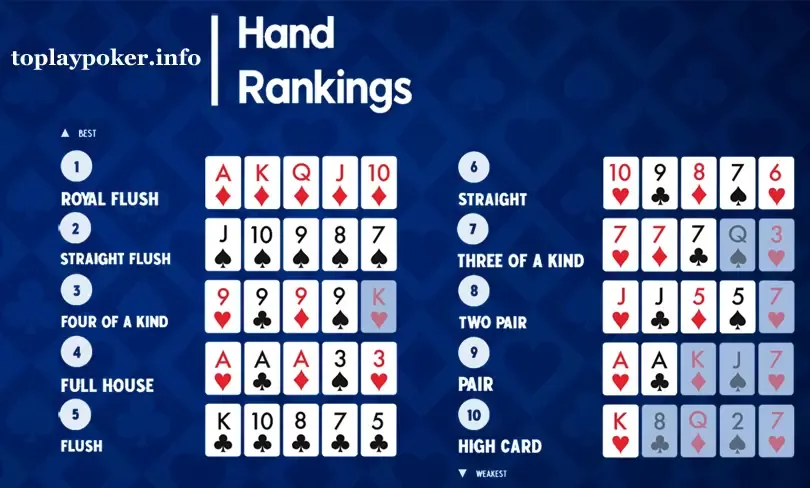
- Royal Flush —
The rarest and unbeatable hand: A, K, Q, J, 10, all of the same suit. - Straight Flush —
Five consecutive cards of the same suit. - Four of a Kind (Quads) —
Four cards of the same rank. - Full House —
Three of a kind combined with a pair. - Flush —
Any five cards of the same suit, regardless of order. - Straight —
Five consecutive cards of mixed suits. - Three of a Kind (Set/Trips) —
Three cards of the same rank. - Two Pair —
Two distinct pairs in the same hand. - One Pair —
Two cards of matching rank. - High Card —
The highest individual card in your hand when no other combination is made.
5. Top 5 Beginners Poker Strategy Tips in 2026
To avoid losing your chips to seasoned “Sharks” and aggressive regulars, follow this fundamental beginners poker strategy:
- Play a Tight-Aggressive (TAG) Style: Play fewer hands, but when you do play, be aggressive. Stick to premium starting hands like AA (), KK (), QQ (), and AK ().
- Understand the Power of Position: Acting late (from the Cutoff or Button) gives you an incredible information advantage. Be much more cautious when playing from early positions like Under the Gun (UTG).
- Target the Right Opponents: Look for “Fish” (inexperienced players) and “Whales” (players who play too many hands loosely). Avoid challenging “Nits” (extremely tight players) unless you have a premium hand.
- Control Your Tilt: Emotional reactions to bad beats (Tilt) ruin more bankrolls than bad luck. Learn to walk away when frustration sets in.
- Master Bankroll Management: Never risk your entire bankroll in one session. A general rule for surviving the micro-stakes is to have at least 20 to 30 buy-ins for the level you are playing.
6. Where to Practice How to Play Poker for Beginners Online
When learning how to play poker for beginners, the best way to master the game is by actually playing. We highly recommend starting your journey on these top-rated platforms designed with soft fields and excellent bonuses for new players.

CoinPoker is the leading crypto poker room in 2026. It offers no-KYC registration, seamless USDT/CHP mechanics, and a fantastic 33% rakeback system.

TigerGaming Poker is an excellent choice if you prefer soft fields full of recreational sports bettors. They also offer a massive 100% welcome bonus for new players.
FAQ: How to Play Poker for Beginners
Texas Hold’em is the most beginner-friendly poker variant. It has simple rules, is widely available online, and is the most popular version in the world.
You can start with as little as $5–$10 at micro-stakes tables online. Focus on learning and improving your game mechanics rather than trying to win big quickly. Always practice proper bankroll management.
Not often. Bluffing is extremely risky if you don’t yet understand your opponents’ ranges or table position. New players should focus on a Tight-Aggressive (TAG) style, playing strong hands and learning the game flow before attempting complex bluffs.
Yes! Many top poker sites offer free play games, also known as ‘play money’ tables, where you can practice without risking real money. They are a great way to learn the betting rules and familiarize yourself with the software.


Facebook Comments