
 Posted by
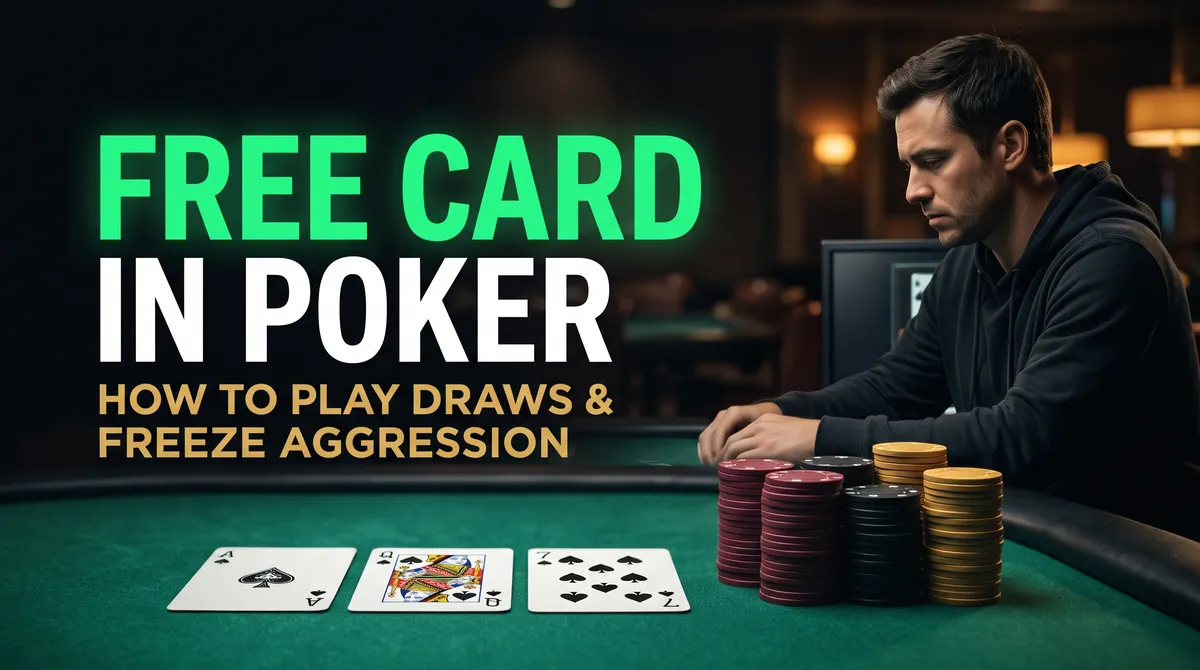
A free card poker strategy involves advancing to the next community street—either the turn or the river—without having to call a bet. Executed through positional advantage by checking behind, or defensively via a semi-bluff check-raise out of position, taking a free card allows drawing hands to realize equity cheaply, while giving a free card allows players with nutted hands to trap aggressive opponents on dry boards.


In modern poker theory, managing the size of the pot and dictating street-by-street action is paramount. A “free card” describes any scenario where the betting round completes with all active players checking. If you are heads-up on the button against the big blind and the big blind checks, you can grant yourself a free card simply by checking behind.
Strategically, elite players deploy the free card concept for two completely different mathematical reasons:
- Realizing equity with drawing hands: Seeing the turn or river at zero immediate cost when you hold a draw, maximizing your GTO poker strategy baseline by realizing your hand’s mathematical potential.
- Extracting value via deception: Underrepresenting a monstrous, nutted holding on uncoordinated boards to induce bluffs or allow an opponent to catch a second-best, playable pair.
Securing a free card is a powerful tactical weapon tightly integrated with concepts like semi-bluffing, board coverage, and positional leverage.
Playing for a Free Card with Drawing Hands
The primary offensive application of this strategy is “buying” a free card to prevent an opponent from firing a large, mathematically incorrect barrel on the turn. By taking aggressive action on the flop, you seize the betting lead, heavily increasing your fold equity in poker while frequently saving money if your draw misses on the subsequent street.
To successfully execute a play to buy a free card, look for the following criteria:
- Heads-up pots: The play is strictly designed for single-raised, heads-up pots. Attempting this multiway drastically reduces fold equity and exposes you to higher variance.
- Positional dynamics: While checking behind in position is the easiest way to take a free card, executing a check-raise out of position is the strongest way to force a free card on the turn.
- High-equity draws: You need a hand that can comfortably call a 3-bet if your aggression goes wrong, such as a nut flush draw, an open-ended straight draw, or a combo draw.
Consider the following tactical setup out of position:
Hero holds:
Flop:
In this scenario, Hero holds the nut flush draw out of position against a single opponent. Strong draws with overcards are the optimal vehicle for this aggressive play.
We begin by checking the flop. If the opponent checks behind, our objective is instantly achieved: we realize our equity and see a completely free turn card. However, if the opponent fires a continuation bet, the action returns to us. Rather than passive calling—which caps our range and invites heavy turn barrels—we execute a semi-bluff check-raise.
This raise accomplishes two modern theoretical objectives. First, it generates immediate fold equity, allowing us to win the pot uncontested against marginal hands. Second, if the opponent calls, they are heavily inclined to check behind on the turn when we check to them, respecting our flop aggression. Consequently, our flop raise “buys” us a free look at the river card.
If the opponent instead 3-bets our flop raise, we are rarely in bad shape. With the nut flush draw and an overcard (12 clean outs), we possess roughly 35% to 45% equity against most ranges. You can quickly calculate pot odds effectively here: a standard 3-bet usually requires around 30% to 33% equity to break even, making our hand an easy, profitable call or shove.

Core Advantages of Buying a Free Card
- Future Street Cost Control: Taking the aggressive lead on the flop freezes the opponent, allowing you to cap the price of seeing the river at the cost of your flop raise.
- Range Deception: A semi-bluff raise conceals your drawing hand, balancing your value range (like flopped sets or two pairs).
- Immediate Pot Acquisition: You don’t need to hit your draw to win if your opponent folds their equity right away.
Giving a Free Card to Your Opponent (Trapping)
Giving a free card operates on an entirely different strategic principle: slow-playing monsters on heavily locked-down boards to build a pot that would otherwise yield no action.
Hero holds:
Flop:
This is a solver-approved scenario for checking. You hold top set—the absolute nuts—on a bone-dry, rainbow board. Crucially, because you hold two Kings and there is one on the board, you suffer from the removal effect (blockers). You heavily block the opponent’s ability to hold top pair. If you bet, standard preflop ranges will instantly fold, as they rarely connect with a seven or a deuce.
When acting last in position, checking behind gives the opponent a free turn card. By checking, you achieve two goals:
- Equity Improvement for the Opponent: The turn card might give them a playable second-best hand (like a weak pair) that is finally willing to call a bet.
- Inducing Bluffs: Showing passivity encourages aggressive, hyper-active opponents to take a stab at the pot on the turn with pure air.
Navigating Subsequent Streets After Giving a Free Card
Suppose you grant the free card on the flop, and the turn arrives as:
Turn:
The board texture shifts immediately. The introduces potential straight draws (such as 9-T, 6-5) and a spade flush draw. While your top set is still overwhelmingly the favorite, the free card period must end.
On dynamic turn cards, you must transition to betting or raising. You must charge the very draws your opponent just picked up, extracting value from newly formed marginal pairs. Do not hesitate out of fear that they will fold. If they fold to a turn bet, they had zero equity anyway; if they call, you are extracting maximum value while denying them a cheap river.
To Give or Not to Give: The Ultimate Decision Matrix
Deciding whether to grant an opponent a free card boils down to evaluating board textures and range vulnerabilities. If the board presents multiple draws that could out-flop or out-turn your current holding, giving a free card is a catastrophic mathematical error. When the next card can destroy your action or complete obvious draws, bet decisively to deny equity.
| Situation | Hero’s Holding | Board Texture | Optimal Action | Strategic Goal |
|---|---|---|---|---|
| Drawing Out of Position | Strong Draw (Nut Flush / OESD) | Wet / Coordinated | Check-raise flop, check turn | Generate fold equity, realize river equity for one bet |
| Drawing In Position | Marginal to Strong Draw | Any texture | Call flop bet or check behind | Guarantee a free card with absolute positional control |
| Value Monster Out of Position | Top Set / Full House | Bone-dry (Uncoordinated) | Check-call flop or check-raise turn | Induce bluffs and disguise absolute hand strength |
| Value Monster In Position | Top Set / Quads (Heavy Blockers) | Completely disconnected | Check behind on flop | Allow opponent to catch a second-best pair on turn |
| Vulnerable Made Hand | Top Pair / Overpair | Dynamic / Draw-heavy | Bet heavily for value and protection | Charge drawing hands; strictly deny free cards |
Conclusion: Weaponizing the Free Card
Integrating a mathematically sound free card poker strategy allows you to manipulate pot sizes and balance your ranges. By utilizing aggressive flop check-raises with strong draws, you generate crucial fold equity while unlocking the option to take a free card on the turn if needed. Conversely, recognizing dry board textures allows you to trap opponents safely, giving them enough rope to hang themselves with bluffs or second-best hands.
At the tables, free cards are never passive coincidences—they are deliberate tactical decisions governed by position, blockers, and board connectivity. Master this dynamic, and you will simultaneously plug defensive leaks and boost your aggressive equity realization.
FAQ: Free Card Poker Strategy
Taking a free card means advancing from the flop to the turn (or turn to the river) without putting additional chips into the pot. Players achieve this either by checking behind in position or by executing an aggressive semi-bluff raise to dissuade their opponent from betting the subsequent street.
When you check-raise the flop out of position, you represent significant hand strength. If the opponent calls, they are highly likely to check behind when you check to them on the turn, allowing you to see the river card without facing another bet.
Giving a free card is a major error on dynamic, wet boards featuring multiple straight and flush draws. If the next community card can easily improve your opponent’s range to a winning hand, you must bet to deny their equity and charge them to see the next street.
🎯 Inspired by the News? Ready to Play?
Test your poker strategy and claim premium bonuses at our top-rated US-friendly poker platforms:

CoinPoker — #1 Crypto Poker Room
Enjoy anonymous blockchain tables, 33% rakeback, and instant USDT cashouts.

BetOnline — Best Soft Cash Games
Experience ultra-soft cash games filled with recreational players, plus a 100% deposit bonus up to $1,000.
Facebook Comments