
 Posted by
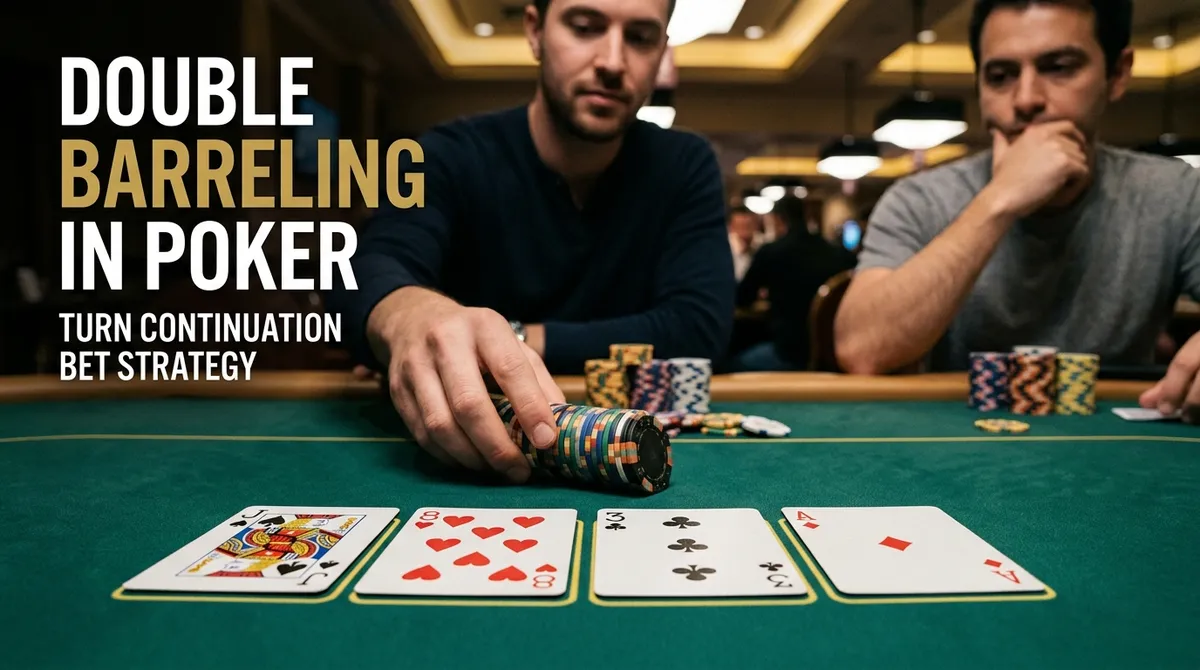
 A double barrel poker play is a continuation bet fired on the turn after previously making a continuation bet on the flop. Primarily executed as a semi-bluff or for value, double barreling applies sustained pressure on your opponent, targeting favorable turn scare cards to force marginal holdings to fold.
So, you fire a continuation bet on the flop, but your stubborn opponent calls once again. You arrive on the turn staring at an awkward card, scrambling to formulate a coherent plan. What should your next move be?
Firing the “second barrel”—or double barreling—is the subtle art of following up your flop aggression with another bet on the turn. It is not an easy play to master. Because the pot has swollen, betting the turn requires risking substantially more money than on earlier streets. You must understand the strategic fundamentals before committing chips.
First, Master Flop Continuation Bets
Most trainwrecks on the turn are the direct result of careless flop continuation bets (c-bets). If you lack a clear strategy on the flop and mindlessly fire c-bets across every texture while hoping for the best, your turn decisions will inevitably degenerate into costly guesswork.
Constructing a disciplined flop c-betting framework is an essential prerequisite to turn play. If your flop range is unorganized, resolve that foundational leak before attempting to calibrate advanced turn barrels.
Core Fundamentals of Double Barreling
- Never double barrel into calling stations: Bluffing players who refuse to fold marginal hands is a fast track to torching your bankroll.
- Player reads remain vital: Opponent tendencies dictate your profitability more than your absolute hand strength.
- Avoid barreling with zero equity: Always prefer semi-bluffs that retain drawing outs over total air bluffs.
- Barrel on scare cards: Target cards that improve your perceived range while worsening your opponent’s holdings.
- Barrel for value when you improve: Balance your bluffs by firing second barrels when the turn legitimately connects with your hand.
Bluffing into passive “calling stations” can be tempting, but it is fundamentally unprofitable. If an opponent routinely calls multiple streets with weak pairs, executing a multi-street bluff will decimate your winrate. Reserve turn bluffs for opponents capable of finding the fold button.
Understanding opponent habits makes your decision straightforward:
- If an opponent frequently floats flop c-bets with speculative holdings, turn barrels will generate tremendous fold equity.
- If an opponent rarely continues past the flop without a strong made hand, shutting down is usually the optimal adjustment.
- If an opponent cannot resist seeing showdowns at any cost, check and save your chips.
When you double barrel as a bluff or semi-bluff, you intend to claim the pot immediately. However, having residual equity cushions the blow whenever your bet gets called. If you fire a flop c-bet with two overcards—such as —you want the turn to offer at least one live overcard to the board. Holding one overcard represents the bare minimum equity floor you should demand before pulling the trigger on a second barrel. The more equity and backdoor potential your hand retains, the more profitable the bluff becomes.
Crucially, if the turn card is frightening for your opponent’s range, your fold equity skyrockets. Finally, you must barrel whenever the turn improves your hand into a genuine value holding. If you only bet the turn when you miss, observant opponents will quickly exploit your betting patterns.

When to Fire a Second Barrel
While turn textures present an endless array of board dynamics, turn cards generally divide into three strategic categories: prime candidates, unfavorable textures, and situational opportunities.
Good Turn Cards to Double Barrel
The premier cards to double barrel are overcards to the flop:
- Flop: — Turn:
- Flop: — Turn:
- Flop: — Turn:
These turn cards are ideal because they heavily favor your perceived preflop aggressor range while punishing the caller’s range. Opponents typically call flop c-bets with top pair, middle pair, or gutshots. When an overcard hits, their one-pair hands are instantly degraded. Because high Broadway cards squarely hit your preflop raising range, your opponent must fold a large portion of their flop calling range rather than risk significant chips with an underpair.
Bad Turn Cards to Double Barrel
Unfavorable turn cards are low undercards or cards that pair the board:
- Flop: — Turn:
- Flop: — Turn:
- Flop: — Turn:
These cards do nothing to threaten your opponent’s continuing range. An opponent who called the flop with second pair or a draw sees zero reason to fold when a rag or pairing card lands. Because their relative hand strength remains intact, firing another bluff into this board texture results in frequent calls.
Acceptable Turn Cards for Situational Bluffs
A middle category consists of Broadway cards that rank just beneath the highest flop card:
- Flop: — Turn:
- Flop: — Turn:
- Flop: — Turn:
These cards provide moderate fold equity. They put intense pressure on an opponent’s middle or bottom pairs from the flop. However, if your opponent called the flop with top pair, these intermediate Broadway cards rarely frighten them into folding. Barrel these cards selectively, relying on clear reads that your opponent tends to peel flops light and fold turns.
Double Barrel Decision Matrix
| Turn Card Category | Board Texture Example | Default Decision | Range & Equity Dynamics |
|---|---|---|---|
| Flop Overcard | Flop: Turn: | High-frequency second barrel | Heavily favors preflop raiser’s perceived range; demotes opponent’s one-pair holdings. |
| Undercard / Blank | Flop: Turn: | Check / Give up pure bluffs | Fails to alter board texture; opponent comfortably continues with their entire flop calling range. |
| Board-Pairing Card | Flop: Turn: | Check behind or check-fold | Reduces combination of potential made hands while strengthening opponent’s calling confidence. |
| Secondary Broadway | Flop: Turn: | Situational / Read-dependent | Pressures second-best flop pairs, but rarely forces top pair to fold. Profitable against floaters. |
Conclusion: Mastering Turn Aggression and Board Dynamics
Executing a disciplined double barrel poker strategy hinges on recognizing turn scare cards that hit your perceived range and avoiding bluffs when holding zero equity. By consistently firing second barrels on overcards that degrade your opponent’s calling range, you systematically expand your non-showdown winnings. Eliminating low-equity turn stabs against inelastic opponents preserves critical big blinds, directly driving higher winrates over meaningful sample sizes.
When applying these concepts at the tables, remember that getting called on your second barrel does not obligate you to shove the river. If your turn semi-bluff misses and your opponent shows no sign of yielding, simply check and surrender the pot rather than spewing chips blindly. To refine your complete multi-street aggression plan, study our guides on how to execute a profitable poker semi-bluff and calculating your exact fold equity in poker.
FAQ: Double Barreling in Poker
A double barrel occurs when the preflop aggressor makes a continuation bet on the flop and follows it up with a second continuation bet on the turn.
Overcards to the highest card on the flop (such as an Ace or King on a Jack-high board) are the best cards to barrel because they strengthen your perceived range and weaken your opponent’s marginal calling range.
No. If your second barrel is called on the turn and the river fails to improve your hand or provide a convincing bluff card, checking or giving up is often far more profitable than risking more chips with a desperate triple barrel.
🎯 Inspired by the News? Ready to Play?
Test your poker strategy and claim premium bonuses at our top-rated US-friendly poker platforms:

CoinPoker — #1 Crypto Poker Room
Enjoy anonymous blockchain tables, 33% rakeback, and instant USDT cashouts.

BetOnline — Best Soft Cash Games
Experience ultra-soft cash games filled with recreational players, plus a 100% deposit bonus up to $1,000.
Facebook Comments