
 Posted by
 Playing out of position (OOP) is universally considered the hardest spot in No-Limit Hold’em. You have less information than your opponent, and realizing your equity is significantly more difficult. However, many intermediate players make a critical mistake: they either c-bet out of position too often (autopilot) or play too passively.
In this guide, we will dismantle the OOP c-bet strategy. You will learn when to fire a continuation bet, how to choose the right sizing, and why checking might be your most powerful weapon.
Why C-Betting OOP is Different from IP
When you are In Position (IP), you have the luxury of acting last. This allows you to dictate the pace of the hand. When you are OOP, the dynamic changes due to a concept called Range Disadvantage.
Typically, the pre-flop caller (who is often in position) has a condensed range that connects better with many flop textures. Because of this, modern GTO (Game Theory Optimal) solvers suggest checking much more frequently when OOP compared to playing IP.
Key Takeaway: You cannot c-bet with the same high frequency OOP as you do IP. Your goal is to protect your checking range, not just attack the pot.
When Should You C-Bet Out of Position? (The Checklist)
Before you put chips in the pot, run through this mental checklist. If the situation doesn’t meet these criteria, a check is likely the superior play.
Board Texture Analysis
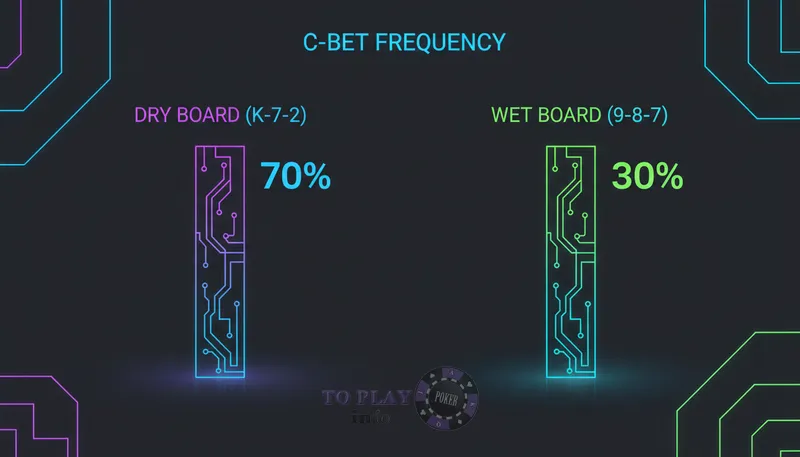
The texture of the flop dictates your frequency.
- Dry, Disconnected Boards (e.g., K-7-2 rainbow): These are excellent for c betting out of position. Your range advantage is usually intact here, and it’s hard for the opponent to have a strong hand.
- Wet, Dynamic Boards (e.g., 9-8-7 with a flush draw): Proceed with caution. These boards favor the caller’s range. Your c-bet frequency should drop significantly here.
Nut Advantage
Do you have more combinations of the strongest possible hands (sets, two pairs) than your opponent? If yes, you can apply more pressure.
Optimal OOP C-Bet Sizing
Choosing the right OOP c-bet sizing is just as important as the decision to bet. Since we are betting less often, our strategy often becomes “Polarized”.
- Small Size (33% Pot): Use this on very dry boards where you want to bet your entire range (Range Bet) or deny equity to random overcards.
- Large Size (66-75% Pot): Use this on dynamic boards when you have a strong hand or a strong semi-bluff. When you are OOP, you want to extract maximum value immediately or fold out opponent’s equity.
The Art of Checking: Protecting Your Range
The biggest leak players have is a weak checking range. If you only check when you give up, observant opponents will stab at the pot 100% of the time you check.
To counter this, you must include strong hands in your checking range (Check-Call or Check-Raise). This is known as defending your checking range.
Hands to Check-Call: Medium strength hands (second pair), strong draws.
Hands to Check-Raise: Sets, two pairs, and high-equity draws (flush draws + overcards).
Common Mistakes to Avoid
- C-betting “Air” on Connected Boards: Don’t bluff on a J-T-9 board just because you were the pre-flop aggressor.
- Ignoring Stack-to-Pot Ratio (SPR): If the SPR is low, you are committed. If it’s high, play more cautiously.
- One-and-Done: Betting the flop and giving up on the turn on every scare card makes you easy to exploit.
Conclusion
Mastering the c-bet out of position strategy takes discipline. Remember: checking is not a sign of weakness; it’s a strategic necessity. By constructing a protected checking range and choosing your betting spots carefully, you will turn one of the hardest spots in poker into a profitable one.
Want to learn more about post-flop play? Check out our guide on Double Barrel Bluffing or improve your pre-flop game with our Hand Rankings Guide.
FAQ: C-Betting OOP Strategy
Modern solvers suggest a lower frequency compared to playing in position. On average, a c-bet frequency of 30-40% is standard for OOP play in single-raised pots, though this varies heavily based on board texture.
Yes, Ace-high boards generally favor the pre-flop aggressor’s range. You can c-bet these boards with a high frequency, often using a smaller sizing.
Consider check-raising when you have a very strong hand (value) or a strong draw (bluff) on a board that hits your opponent’s range. This punishes their aggression and builds the pot when you are likely ahead.
🎯 Ready to master your out-of-position play? Test these C-bet strategies in real games on CoinPoker or Tigergaming Poker.


Facebook Comments