
 Posted by
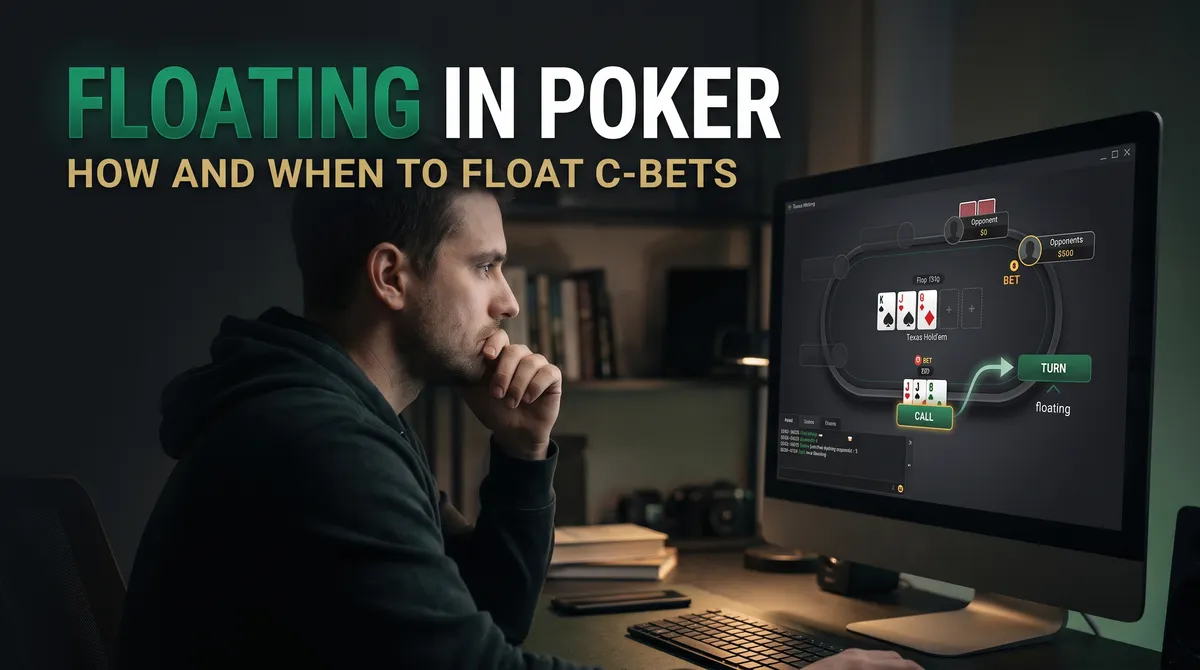
Floating in poker is an advanced multi-street bluff where a player calls an opponent’s continuation bet on the flop with a weak or unmade hand, intending to take the pot away with a bet on the turn when the opponent checks, capitalizing on shown weakness and positional advantage.


What Does Floating Mean in Poker?
Floating is an advanced bluffing technique in Texas Hold’em that develops across multiple streets. The primary concept behind this move is to call the flop with the specific intention of convincing your opponent on the turn that your hand is stronger than theirs, ultimately forcing them to surrender the pot before the river.
Essentially, executing a float involves calling an opponent’s continuation bet (c-bet) on the flop (“floating the flop”) and subsequently firing a bet on the turn when that opponent checks to you. Because this line relies on strategic leverage rather than card strength, it can theoretically be executed with almost any two cards, making it an indispensable weapon in your multi-street bluffing arsenal.
Why Is Floating So Effective?
This play works exceptionally well because the average poker player treats the flop continuation bet as an automatic, default action—firing regardless of whether they connected with the board. Consequently, opponents frequently c-bet with complete air, hoping you missed the flop or assuming that persistent aggression alone will win them the chips.
When you call their flop c-bet, it sounds an immediate alarm for the aggressor. Your flat-call signals that you might be slowplaying a monster hand or holding a resilient made hand that has no intention of folding. When faced with this resistance, the majority of players shut down and check the turn. This allows you to capitalize on their displayed weakness by making a well-sized turn bet to scoop the pot uncontested.
Put simply, floating serves as one of the most effective tactical counters to wide, undisciplined continuation bets.
Key Conditions for a Successful Float
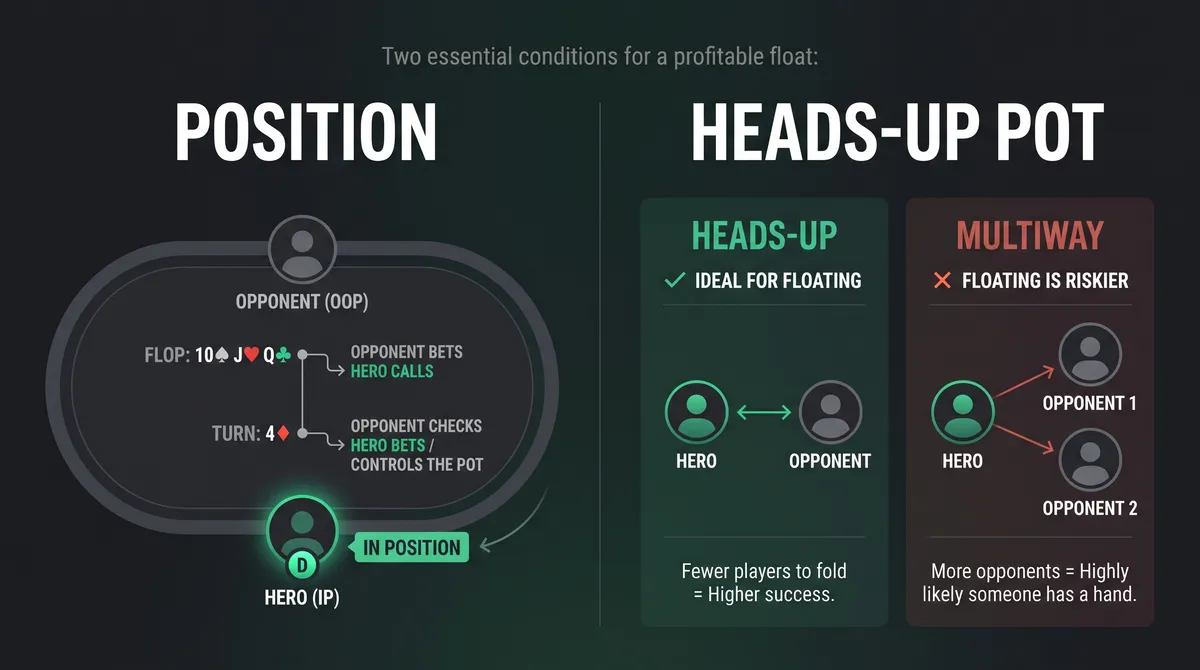
To execute a profitable float, two foundational parameters must be satisfied before you commit chips to the pot:
- You must have absolute position: You need to act after your opponent on every postflop street.
- The pot must be heads-up: You should only be contending against a single adversary.
While pulling off an out-of-position float is technically possible, doing so is drastically more complex, volatile, and expensive. When you have position, you gain the luxury of seeing how your opponent reacts on the turn after your flop flat-call. If they fire another hefty bet on the turn, you can comfortably fold, recognizing that their range remains strong. If they check, you find yourself in the driver’s seat to seize the pot.
Equally critical is keeping the field heads-up. In multiway pots, executing this type of sophisticated pure bluff becomes significantly harder because the mathematical probability that at least one opponent connected with the board rises sharply. Furthermore, multiway callers rarely give your flop call the respect it commands in a heads-up duel. Keep your floating strategy strictly confined to heads-up confrontations in position.
Step-by-Step Hand Example of a Turn Float
To see how floating functions in practice, consider a standard $1/$2 No-Limit Hold’em cash game:
A player opens from middle position to $8. Action folds around to us on the button holding an unmade speculative hand. We make the call, and both blinds fold. The flop is dealt dry and uncoordinated, completely missing our hand. The preflop aggressor fires a continuation bet of $16 into the $19 pot.
Under conventional guidelines, an unmade hand with zero direct equity warrants an immediate fold. However, knowing that this specific opponent fires flop c-bets with high frequency regardless of board texture, we call the $16 bet with the plan of floating. The turn brings a blank card that does not alter the board state. Our opponent checks, signaling hesitation and weakness.
We seize the opportunity and fire a bet of $40 into the $51 pot. Suspecting that our flop call was backed by genuine strength, the opponent quickly surrenders their cards, awarding us the pot.
Hand Analysis and Bet Sizing
In this dynamic, the initial raiser routinely c-bets Broadway holdings like A-K, A-Q, K-Q, or vulnerable pocket pairs such as 9-9 or 7-7. Our flat-call on the flop creates substantial distress for their range. To them, our calling range contains numerous combinations that have them crushed, including top pairs, two pairs, and well-disguised sets.
When the turn checks through, our robust bet of roughly three-quarters of the pot makes it mathematically prohibitively expensive for their marginal holdings or unimproved overcards to peel another card. A firm turn bet size is vital: it credibly represents genuine value while denying the opponent favorable pot odds to draw out on the river.
What happens if the opponent fires a second barrel on the turn? While select aggressive players will double-barrel with air, attempting to raise a turn second barrel as part of a float is an extraordinarily high-risk, advanced maneuver. Unless you possess airtight reads that your opponent is capable of firing multiple bluff barrels and folding to turn raises, the standard, disciplined response to a second barrel is to release your hand.
Core Strategic Rules for Effective Floating
To preserve your winrate and prevent costly blunders, integrate two golden rules whenever considering a float:
Know Your Opponent’s Profile
Reliable reads are mandatory. Floating requires an opponent who demonstrates a wide flop c-betting frequency but possesses the discipline to fold when met with resistance on subsequent streets. Tight-aggressive (TAG) players are prime targets because they understand relative hand strength and respect perceived danger. Conversely, never attempt to float a “calling station” or loose-passive player who is incapable of folding middle pair or weak draws.
Do Not Overuse the Float
Floating should not become your automatic reflex against every continuation bet. If you overuse this maneuver, observant opponents will adjust by check-raising turn cards, double-barreling wider, or trapping you with protected ranges. Floating is an opportunistic exploit that presents itself naturally within favorable table dynamics; you should never force the move preflop before evaluating the texture and your opponent’s tendencies.
Floating Decision Matrix
| Game Factor | Favorable Float Setup | Unfavorable Float Setup |
|---|---|---|
| Position | In position (Button, Cutoff) | Out of position (Blinds vs In-Position) |
| Opponent Style | High Flop C-Bet / High Fold to Turn Bet | Calling Station / Multi-Barrel Aggressor |
| Number of Players | Heads-up single-raised pot | Multiway pot (3+ players) |
| Turn Action | Opponent checks showing capped weakness | Opponent fires a large second barrel |
| Turn Bet Sizing | 60% to 75% pot bet to maximize fold pressure | Small min-bet granting easy drawing odds |
Conclusion: Integrating the Float into Your Strategy
Mastering floating in poker expands your postflop edge by allowing you to systematically exploit opponents who bet too frequently on the flop without a long-term plan for the hand. By calling with position and executing decisive turn bets when checked to, you convert otherwise dead holdings into positive expectation. Over a large sample of hands, turning these marginal pots into uncontested wins directly accelerates your overall winrate and prevents aggressive opponents from running over your table image.
To execute floats with maximum profitability, maintain disciplined table selection and carefully evaluate whether you have enough fold equity in poker before peeling the flop. Combine this multi-street bluff with comprehensive habits for profiling opponent player types and styles, ensuring you only direct your floats against players capable of laying down hands when the pressure intensifies on the turn.
FAQ: Floating in Poker
Floating is a multi-street bluff where you call an opponent’s flop continuation bet in position with an unmade or weak hand, intending to bet and win the pot when they check to you on the turn.
Floating out of position requires you to act first on the turn, stripping away the ability to see whether your opponent checks to reveal weakness. This makes the bluff far more expensive and difficult to execute.
Avoid floating against loose-passive calling stations who cannot fold weak pairs, as well as hyper-aggressive opponents who routinely fire multiple bluff barrels across the turn and river.
🎯 Inspired by the News? Ready to Play?
Test your poker strategy and claim premium bonuses at our top-rated US-friendly poker platforms:

CoinPoker — #1 Crypto Poker Room
🔥 +15% Rakeback + Up to 50% Rewards · No KYC
150% deposit bonus up to $2,000, anonymous blockchain tables, daily cash game leaderboards, and instant USDT cashouts.

BetOnline — Best Soft Cash Games
Experience ultra-soft cash games filled with recreational players, plus a 100% deposit bonus up to $1,000.

SwC Poker — 100% Anonymous Bitcoin Action
Play entirely without KYC verification. Enjoy daily Bitcoin cashouts, huge Mixed Games action, and up to 50% rakeback.

Facebook Comments